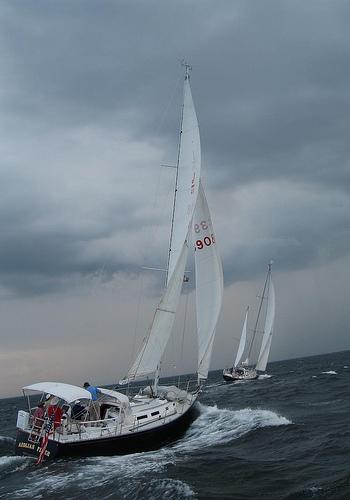
If one does not know to which port one is sailing, no wind is favorable.

If one does not know to which port one is sailing, no wind is favorable.Seneca

What does that mean?
To me, the saying is about your destination. If you don’t have one, no wind can possibly take you there. You must have an idea of where you wish to go, what your destination or goal is. Without it, you are adrift. Without it, the wind becomes irrelevant.

This is similar to, but the opposite of, the Lewis Carrol quote from a few weeks back. In that quote, Alice asked the Cheshire Cat which road will take her away from where she was, to which the Cat replied that any road would do. Here, we discuss that without a destination, you have no favorable wind, no way of getting there.

Why is a destination or goal important? Continue reading

Posted in destination, goals | Tagged , , , | 4 Comments

There is one kind of robber whom the law does not strike at, and who steals what is most precious to men: time.

There is one kind of robber whom the law does not strike at, and who steals what is most precious to men: time.Napoleon Bonaparte

Who is stealing your time?

What does that mean?
Time, the most precious of all things to mankind. There is no replacing it, no getting it back. Once it is gone, your choices are to make the best of what is left, or lose even more time thinking about what might have been, if only you had that time back. That’s not very helpful, is it?

He states, quite interestingly, that the law gives us recourse to anyone who steals anything of ours, except those who steal our time. I found that a very interesting distinction. I don’t know if we can prove ownership of our own time or not, but it would certainly make phone calls from salespeople much more interesting.

Why is time important? Continue reading

Posted in time | Tagged , , | 2 Comments

If your strength is small, don’t carry heavy burdens. If your words are worthless, don’t give advice.

If your strength is small, don’t carry heavy burdens. If your words are worthless, don’t give advice. – Chinese Proverbs

What does that mean?
Most of the quotes that have been discussed here have been about our strengths or developing our strengths. This quote is about the things we aren’t good at. It is about recognizing our weaknesses. It advises us to be willing to admit to ourselves that we have things that we are not good at. The quote finishes by asking us to refrain from the things we are not good at.

Why is recognizing your weaknesses important?
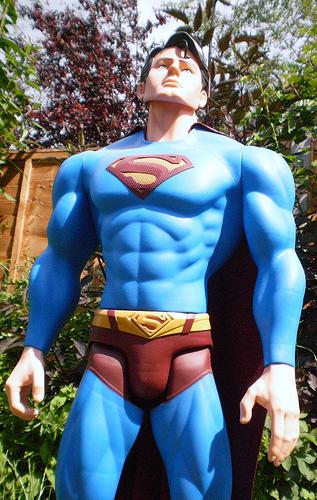
Not even Superman is good at everything. He has a weakness. He knows what it is, and he takes precautions against it. Everyone has their own private version of kryptonite. If we don’t know what ours is, how can we take precautions against it? Continue reading

Posted in weakness | Tagged , , | 2 Comments

When dealing with people,remember you are not dealing with creatures of logic,but creatures of emotion.

When dealing with people, remember you are not dealing with creatures of logic, but creatures of emotion.Dale Carnegie

What does that mean?
We, even the most logical of us, are creatures of emotion. Yes we have our logical moments, but under all that calm logic lurks the chaos of emotion. It might hurt sometimes to admit it, but it is true. Dale is warning us against being too logical, and imploring us to remember that however logical our reasoning may be, it will most likely be taken, by the listener, in an emotional manner.

Why is emotion important? Continue reading

Posted in emotion | Tagged , , | 2 Comments

Most people have the will to win, few have the will to prepare to win.

Most people have the will to win, few have the will to prepare to win. – Bobby Knight

What does that mean?
In sports, preparation is everything (with the possible exception of luck). You have to know your plays and plans inside and out. You need to know the other players like you know yourself. If something goes wrong with the play, where will the other players go?

If you can’t answer those questions, you haven’t done enough preparation. And there really aren’t any shortcuts. Then there are the fundamentals. Someone who practices the basics for hours every day is much less likely to goof up on game day.

The lists could go on for quite a while, but if you’ve ever played a sport or worked hard in a competition, you know what I’m talking about. That is what separates the professionals from the talented amateurs. The job of the professional is to prepare, full time, year round.

Why is preparation important? Continue reading

Posted in preparation | Tagged , , | Comments Off on Most people have the will to win, few have the will to prepare to win.

If you knew how much work went into it, you would not call it genius.

If you knew how much work went into it, you would not call it genius. – Michelangelo

And that's just half of it!

What does that mean?
To many people, the word ‘genius’ makes it sound like something was easy. E=mc², why that’s just genius – and it sounds so simple. What Michelangelo was trying to point out is that no one sees the amount of work that goes into something that is so breathtakingly spectacular, be it an equation, or the ceiling of a chapel.

This saying also hints at something most people know, if they take a moment to think about it. Genius is just another word for someone who has worked so incredibly hard and come up with something spectacular as a result.

Why is hard work important? Continue reading

Posted in work | Tagged , , | Comments Off on If you knew how much work went into it, you would not call it genius.

The most important thing is to have a sense of responsibility, commitment, and concern for each of our fellow human beings

The most important thing is to have a sense of responsibility, commitment, and concern for each of our fellow human beings. –  Dalai Lama

What does that mean?
This saying seems to be about the duty of each human being towards the rest of humanity. This duty has three aspects, and he implies we should have towards all others a sense of :

  • responsibility, to be trustworthy and reliable towards them.
  • commitment, to be emotionally or intellectually involved in their lives.
  • concern, to be interested and involved in their lives.

When we can put these together, we can truly become a powerful force, helping to move all of humanity forward, towards understanding and harmony. Violate all these, and we risk sliding backwards into distrust and hatred.

Why is duty to our fellow human beings important? Continue reading

Posted in duty | Tagged , , | 3 Comments

While we are postponing, life speeds by.

While we are postponing, life speeds by. – Seneca

Don't let life pass you by, take action!

What does that mean?
It means that time waits for no one. If you make a habit of putting things off, you will find you have run out of time to get things done. If you don’t get out and do things, life will speed by you, and you will very likely regret it.

Life seems to have one speed and one direction (relativistic speeds and some forms of quantum theory aside). Everyone gets the same number of hours in a day, and days in a year. In that, all of humanity is the same. What makes us different is how we make use of the hours, days and years that are given to us.

Why is action important? Continue reading

Posted in action | Tagged , , | Comments Off on While we are postponing, life speeds by.

Who is not satisfied with himself will grow; who is not sure of his own correctness will learn many things.

Who is not satisfied with himself will grow; who is not sure of his own correctness will learn many things. – Chinese Proverbs
What does that mean?
I just love the Chinese quotes, it seems that they are always translated into such odd English. I’ll take a stab at rewording it into two sentences and see if  I can’t help it to sound a little more like English:

The person who is not satisfied with themselves, they will grow. The person who is not sure of their own correctness, they will learn many things.

With this as a starting point, I would say that the root of the saying is dissatisfaction and doubt can be useful tools, if used correctly. They will be most useful to you if you use them to improve yourself, to move forward physically, emotionally, spiritually or intellectually.

At the opposite end are those who believe they are always right and completely satisfied with themselves. They will never seek to learn another thing, nor will they ever make an effort improve themselves in any way. The person with these traits believes themselves to be as close to perfect as they can get, and that is just plain sad.

Why is self improvement important?
Well, I guess that’s the question, isn’t it? How close to perfect are you? In reality, I think most of us know we aren’t even close to perfect. The question then becomes how much effort will it take to move up to the next level, and is it worth it to you?

I don’t expect most of you to have any great use for a body that looks like a Greek statue of a god or goddess. Yeah, it might be nice, but the maintenance is a real pain. Nor do I expect most of you have the need to keep your brain sharp enough to take on a world ranked chess champion or a Nobel Laureate on their own turf.

Spiritually, I don’t think too many of us could challenge the Pope or the Dalai Lama, nor do I think that there is a need to. I can’t think of a measure for emotional growth, but I don’t think very many of you are looking forward to your debut on the The Jerry Springer Show as a big step forward, right?

In short, most of us have some room for improvement in our lives, and some desires to improve as well. I believe that it is a good thing to improve oneself. Eventually, with age, it will become a fight to retain what we used to have, but I know I will continue to try to improve myself. How about you?

Where can I apply this in my life?
What do you want to  do better that you are currently doing? What do you not do (or not do well) now that you want to start doing? Grab some paper and write a few of these ideas down. They can be from any area of your life, from the physical, the mental, the intellectual, the emotional and whatever other ways you might divide your life.

For one thing, I’m a blogger. Obviously, I have much to learn as a blogger. I think my content is fairly solid, but I’m going through some online training classes, trying to work my way up the learning curve. So far, things are going fairly well. But there is still a long way to go, and I’m sure it will take me some time to pull it all together.

How about you? Choose one of the ideas you have written down. You can always come back and try this again with a different idea, so pick one and let’s get started. Even if you are recognized as one of best in your field, you probably have some room for improvement, right?

OK, so you know you need to improve and what you will try to improve, now what? I’d start by trying to figure out what way would be the most practical for you. In some situations, reading or listening is the best way to move forward. In other cases you might have to do physical things or have an additional person with you as a training partner, coach or mentor.

Once you have an idea as to what might be best for your situation, search for it. The internet is a big place. There is lots to buy, lots to research, lots of businesses to find, and people to connect with. There are also friends to ask, papers to read, phone books to look at and whatever other sources you might have.

After all this searching (it probably wasn’t as hard to do as it was to read that mess of a paragraph), you now should have a pretty good idea as to what help is available. Now you just have to fit it into your schedule and your budget. That can be a pain, but it has to be done.

If none of what you came up with in the first attempt fit neither your schedule nor your budget, it’s time to try again, this time with your constraints in mind. You might have passed over learning from a book or a CD or online due to a preference for a coach, but if you can’t afford one, you need a ‘Plan B’.

Whatever your goals are, wherever you’re going, you should strive to improve yourself. A little here, a little there, every week, every month, every year, and pretty soon, you are going to be Awesome (or even more awesome than you already are).

From: Twitter, @AncientProverbs
confirmed at : http://www.thetop100.net/the-art-and-literature-zone/david-roads-top-100-ancient-proverbs/who-is-not-satisfied-with-himself-will-grow-who-is-not-sure-of-his-own-correctn/list/z30l288i103153.aspx
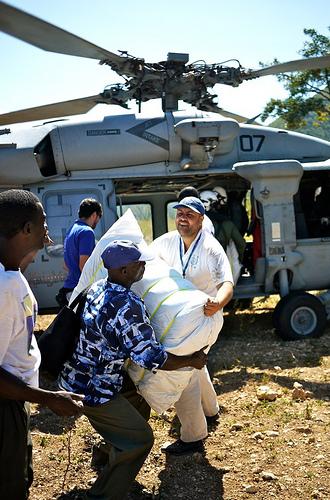
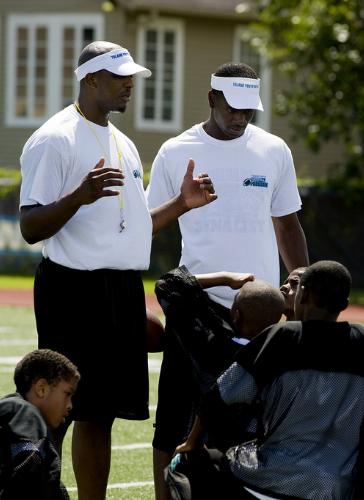
Photo by Tulane Public Relations

Posted in self improvement | Tagged , , | Comments Off on Who is not satisfied with himself will grow; who is not sure of his own correctness will learn many things.

You cannot climb the ladder of success dressed in the costume of failure.

You cannot climb the ladder of success dressed in the costume of failure. – Zig Ziglar

What does that mean?
While I disagree with the old saying “clothes make the man,” I don’t believe this costume of which Zig refers to is clothing. I believe this saying refers to your attitude and your beliefs as the costume.

If you are shrouded in the bad attitude of failure, if you don’t believe you can succeed, it will indeed be very difficult to climb the ladder of success. Not unlike wearing your heart on your sleeve, wearing your bad attitude and lack of belief for all to see will be as obvious to others as if you had a small storm cloud hovering over you, raining.

Why is belief important?
To climb the ladder of success, whether at work, at home, or in sports, you cannot wrap yourself in failure. If you have done so, your very appearance will tend to drive away the very people from whom you most need help. Your posture, your attitude, your facial expression, they will all contribute to, or detract from, to your costume.

Belief is fundamental to your ability to accomplish tasks, whether it’s climbing the ladder of success or getting groceries from the store. If you believe you can do it, and are going to be successful, you can handle a setback and still keep moving forward (or up the ladder). If you are expecting failure, your first setback is an excuse to quit.

Even in the costume of failure, you have a belief, an expectation. In the case of the costume of failure, the expectation is failure. What you believe, you will (with effort, intelligence and courage) achieve. What do you believe that you can or cannot do?

Where can I apply this in my life?
Belief is a powerful force. If you believe the worst of yourself, you have little trouble finding every instance where you did poorly, ignoring all the other times when things went well. It hasn’t changed the past, nor has it actually changed your “batting average,” but you will be less likely to try if you believe it will end in failure.

Not only will you be less likely to try, you will probably not put as much effort into a task if you believe failure is likely, nor will you spend as much time planning or preparing. In short, your belief cheats you of any real chance of success and becomes a self-fulfilling prophesy.

Many people give off clues as to their belief in themselves, or in the compete lack thereof. We just finished watching the whole Harry Potter series of movies, and in the second movie Neville Longbottom asks “Why is it always me?” He had just been picked up by pixies and hung by his clothes from a chandelier.

At the time, Neville was an introvert and believed the worst in himself. He had plenty of data to support his belief, and ignored all the data that didn’t fit his theory. To answer his question, his posture, his face, his expressions and his beliefs completed his costume of failure. And that tends to attract people (or pixies, in this case) who are looking for someone to mess with.

What kind of belief do you have in yourself, and what costume do others see you wearing? Let’s ignore your faults and shortcomings, we all have them (but try not to dwell on them – recognize them, compensate for them and move on).

Grab some paper and write down several successes you have had. They can be from any portion or aspect of your life and at any time in your life. You can come back and repeat this at any time, focusing on specific roles or times, as you desire.

Select one and write a short paragraph about why you were successful. Was it a skill, was it preparation, was it quickness, was it hard work, or was it something else? Now take some time and think through your past, looking for other times you used your ‘success maker’ abilities in other situations. Take brief notes. When you are done, you should have quite the road-map for a rock solid belief in yourself and your success.

Take some time to scroll through the list of successes you achieved using that particular mechanism. How do you feel? This is the real you, without the artificial baggage of fears and failures. Drop the costume of failure and live the life of your possibilities and your abilities.

By the final film of the Harry Potter series, Neville has become both an accomplished leader as well as an accomplished wizard (his earliest fears were that he was a ‘squib’ or a person unable to use magic). He just needed a few successes and a better focus on what he was truly capable of becoming.

You may not turn out to be one of the finest wizards in the world, but you don’t have to spend your life believing you are a failure. We all have failures and successes. What we believe ourselves to be, we will become. Choose wisely, or all might come to ruin.

From: Twitter, @Zig_Quotes
confirmed at : http://www.brainyquote.com/quotes/quotes/z/zigziglar381977.html
Photo by jimmyharris

Posted in belief | Tagged , , | 1 Comment

All men are prepared to accomplish the incredible if their ideals are threatened.

All men are prepared to accomplish the incredible if their ideals are threatened. – Maya Angelou

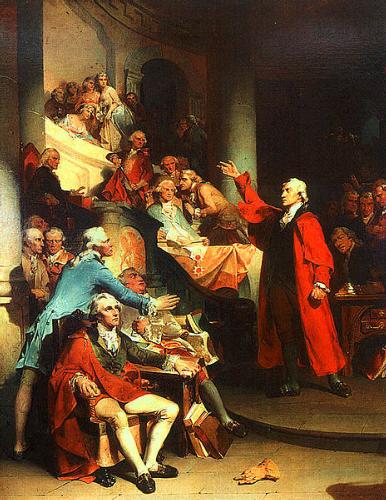
Peter F. Rothermel's "Patrick Henry Before the Virginia House of Burgesses", a painting of Patrick Henry's "If this be treason, make the most of it!" speech against the Stamp Act of 1765

What does that mean?
Maya was part of the American Civil Rights movement, and that may help cast some light on what is being said in this quote. I was unable to find if this was in reference to the people opposing the Civil Rights movement or the people in favor of it, but it seems to apply to both.

When a person has their core beliefs invalidated, they lose not just their identity, but their very foundation. Like the people learning that the earth was round and not flat, it shook them (and their society) to the core.

This is what the quote is about. When those ideals or core beliefs are threatened, people will go to great lengths to protect them. Smaller numbers will do the improbable, and a handful will do the incredible to protect their ideals.

Why are ideals important?
If you ask Patrick Henry, of the American Revolution, he might have had a solid answer (hint: he’s famous for saying “Give me liberty or give me death!”) How is that for being prepared to accomplish something incredible?

At thefreedictionary.com, ideal is defined as “A conception of something in its absolute perfection.” So, what the quote says is that if a the concept of perfection is challenged, the people believing in this perfection are likely to be fairly highly motivated to defend it, right?

Ideals are the concepts against which we measure ourselves, and quite often, our happiness. We derive value and sense of well being from conforming to the ideals of our culture or society. If someone is ‘rocking the boat,’ as it were, we’re not just going to stand by and watch our ideals be torn down, are we? For most of us, the answer is going to be a resounding “No!”

Where can I apply this in my life?
We have seen this principle in our lifetimes. The protests in Wisconsin about the changes in what Unions can and cannot do, to the protests about abortion rights (both pro and con), as well as the uproar over an artist who put a crucifix in a jar and then filled the jar with urine, people reacted strongly.

They were reacting because their view of something that was, if not perfect, certainly very close to it, was being challenged, degraded or reduced in some way or form. I’m not trying to take sides here, but simply to point out, that people are still prepared to do much when their ideals are threatened.

Now, did any of the topics in the first paragraph of this section cause you to get a little steamed, a little angry? Perhaps one of your ideals was threatened in remembrance (that is, you were reminded by one of these incidences of a time when your ideals were threatened)?

Ideals aren’t something I can help you with, nor am I going to suggest to you what you should do if you feel they are threatened, other than to exercise caution. Violence may appear to ‘solve’ the immediate problem, but it will create many other problems, and will only serve to make the overall situation much worse.

What I can do is ask you to write down some of your core beliefs. What do you stand for? What do you consider to be, if not absolutely perfect, close to perfect? What are you willing to go to the greatest lengths to preserve and protect? Will you fight for freedom (as you believe it to be)? Will you fight for peace (not as much an oxymoron as you might think, provided you have a broad view of the word ‘fight’)?

To lightly mangle another quote “Those who stand for nothing will fall for anything.” What do you stand for? What are you willing to lend your effort towards protecting? Regardless of your gender (this quote specifies men), you have values, you have ideals and you have your reasons for believing in them. If you aren’t willing to defend them, are they really ideals, or just a pleasant thoughts?

From: Twitter, @WomenOfHistory
confirmed at : http://www.brainyquote.com/quotes/quotes/m/mayaangelo120862.html
Artwork by Peter_F._Rothermel

Posted in ideals | Tagged , , | Comments Off on All men are prepared to accomplish the incredible if their ideals are threatened.

Follow your hopes and not your fears.

Follow your hopes and not your fears. – Unknown

Also similarly stated by Pope John XXIII as “Consult not your fears but your hopes and your dreams.” This is part of a larger quote: “Consult not your fears but your hopes and your dreams. Think not about your frustrations, but about your unfulfilled potential. Concern yourself not with what you tried and failed in, but with what it is still possible for you to do.” This expanded version of the quote is what I will discuss in the post.

What does that mean?
It means that there is still hope. You can still do something. You can still follow your dreams. There is still some potential, still a chance. If you can turn away from your fears, learn from your failures (instead of dwelling on them) and move beyond your frustrations, you get something done. You can move towards your dreams, you can start doing what is possible and begin to reach your dreams.

Why is hope important?
Without hope, what do you have? By definition, you have hopelessness, right? I don’t even like the sound of that. Being a Cubs fan, I’m familiar with having my hopes dashed, my autumns plagued by the mocking of unfulfilled potential, and the weight of the failures. But there’s always next year. And I mean that, there is always next year.

Life can be a bit of a roller-coaster. It can be up one moment, then down the next. The trick, I have found, is to live neither in the memory of the up, nor in the memory of the down. To not be frustrated that you aren’t always at the top. To not dwell on the misery of the memory from the time when you were all the way at the bottom.

Hope, it is said, springs eternal. It is always welling up, always present. But that’s not true for everyone. It is natural to go through a “winter” phase, a time when all seems cold and bleak. But like winter gives way to spring, so too should your winter give way to spring, and with it, renewed hope. If it doesn’t, you may want to contact a professional for some assistance in getting things back on track.

Where can I apply this in my life?
Grab some paper and write down your hopes and dreams. Ignore your fears, just focus on your hopes and dreams. Where do you want to be in five or ten years? How do you want your circumstances to have changed? How would your life be different?

And now, wave your magic wand, and your dream will come true. No, not really. There will be a lot of thinking, planning and doing involved. There will also be failures, lessons and revisions.

We all have failures. Write them down – not all of them, just the ones applicable to the hopes and dreams you wrote down. Look at each failure. Can you learn a lesson? Perhaps you bit off too much, or needed some better skills. Whatever the failure was, learn a lesson from it, and plan a way to get around it. Write the lesson down and put a single line through the failure. Feel better now? I hope so.

We all have unfulfilled potential. We can do so much more than we usually make ourselves do. If it were impossible for you to be frustrated, what would you do? Write a few ideas down. Put together a quick plan for getting each of them done, perhaps five or six basic steps. Select one of the plans and make it more detailed. Now select the smallest task on the list and do it. Right now! I’ll wait, but time won’t. Is it done yet?

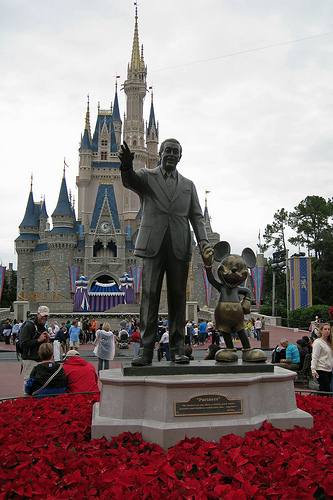
We are all dreamers, although some of us have fallen out of the habit of dreaming. A dream is the start of something great, if you can believe in your dream. Then all that is left is to put together a plan and get busy. Walt Disney turned a dream of a small amusement park for his employees and children into Disneyland, and 47 square miles of swampland in Florida into Disney World.

While Walt Disney may have been one of the greatest dreamers of our era, we can still dream our dreams, and work hard to make them happen. Like the song goes, “You’ve got to accentuate the positive, Eliminate the negative.” Don’t focus on the bad, focus on the good. Don’t focus on the past failures, focus on what you can still do. And always follow your hopes and dreams.

From: Twitter, @DavidRoads
confirmed at : Unknown – all over twitter; also a similar quote by Pope John XXIII at http://www.brainyquote.com/quotes/quotes/p/popejohnxx109443.html
Photo by Beau B

Posted in hope | Tagged , , , , | Comments Off on Follow your hopes and not your fears.

Victory is always possible for the person who refuses to stop fighting.

Victory is always possible for the person who refuses to stop fighting. – Napoleon Hill

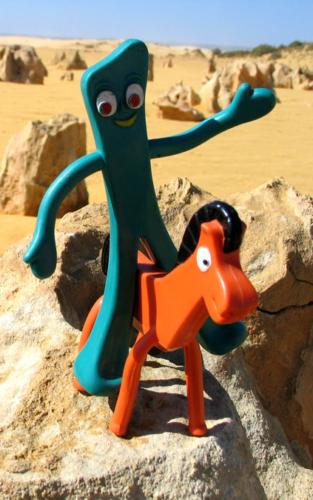
No obstacle can stand in the way of a determined and flexible Gumby!

What does that mean?
It means as long as you are still trying, there is a possibility that you will win. What ‘victory’ means, of course, is very dependent on the person and the task, as is the definition of ‘fighting.’ In most cases, ‘victory’ means achieving a goal, and ‘fighting’ means to continue to exert effort towards the attainment of the goal.

Whether it’s housebreaking a puppy or helping a toddler learn to walk, learning to ride a bicycle or learning to speak a foreign language, if you don’t give up, eventually you’ll achieve victory.

Why is refusing to stop important?
Well, for most people, defeat begins when the effort towards success stops. Does that make sense? You are only truly defeated when you give up. As long as you continue, not to hope, but to act, you can still make things happen. Nothing is guaranteed, of course, but if you aren’t trying, you aren’t as likely to succeed.

There are aspects to moving forward besides sheer determination. No matter how determined you may be, no matter how much effort you put forth, you’re going to have a hard time seeing a sunrise if you only look to the west.

You must remember the principal of flexibility, the ability to change your approach, to change your strategy. You must know when to (quoting a song about a card sharp) “know when to hold ’em, know when to fold ’em, know when to walk a way, and know when to run!”

The winning strategy might not come to you in the first attempt, and you may need to try a few times before you start making progress. You need to use your intelligence and courage to revise and modify your approach. The combination of flexibility and effort will eventually lead you to victory.

Where can I apply this in my life?
In the lives of most people, there are a number of things that seem far off, or if closer, difficult to achieve. For me, learning a foreign language has never been easy. Even English (my native tongue) has been difficult. I tried Spanish, and have the materials for Japanese. What I am lacking at the moment is the effort and the time.

Effort is what I call actually doing something. Learning a language will not be simple, nor will it be quick, but effort will be required. At least a few hours a week need to be set aside and worked on a regular basis. I have yet to make the time available on a regular basis. When it becomes a sufficiently high priority, it will happen, of that I am sure.

Flexibility is being able to vary what you do until you get the proper combination to work. If you do much bowling, you know that it takes a while to get everything just right with your game. Learning the angle to throw at, learning how far over to start, learning how much spin is needed, all these things take experience. And every lane is just a little different, so flexibility is very necessary to getting strikes and high scores.

What is still on your list of things to do? Write a few down on a piece of paper. Now consider each in turn, adding what you think are the three biggest obstacles to you achieving victory in this fight. Please take a moment and work on this, I’ll wait.

Good, now select one of the list items. Look at the three biggest obstacles and determine if each one needs more effort, more flexibility, or both.

For those requiring more effort, how will you do that? Can you devote more hours per week? Can you bring in someone who might be able to provide assistance in some manner, allowing you to surmount the obstacle or blow it away?

For those which require more flexibility, how will you do that? Can you think of a couple new approaches to go over, under or through the obstacle? Can you get someone to help you puzzle out what other options you have, someone who has done something similar or who is good at solving problems?

For those which require both, come up with some ideas to do both. It may not be easy, but it is fairly simple and straightforward, if you just keep fighting. Apply effort, remain flexible and keep at it, and eventually the obstacles to victory will fall away.

Semper Gumby!

From: Twitter, @DavidRoads
confirmed at : http://www.brainyquote.com/quotes/quotes/n/napoleonhi384051.html
Photo by Looking Glass

Posted in effort, flexibility | Tagged , , | Comments Off on Victory is always possible for the person who refuses to stop fighting.

The practice of cultivating altruism…

The practice of cultivating altruism has a beneficial effect not only from a religious point of view but also from a mundane point of view. – Dalai Lama

What does that mean?
At theFreeDictionary.com, altruism is defined as “Unselfish concern for the welfare of others; selflessness.” So this saying, using a substitution becomes “The practice of showing concern for others provides benefits both the religious and mundane aspects of your life.”

Being concerned for others has its place in many religions. While acknowledging that, he goes on to state that it is beneficial to you in your mundane life as well. The benefits on the religious side are between you and your religion. The benefits on the mundane side, they are many, and vary from person to person. They can include feelings of self-worth, satisfaction and a warm, happy feeling inside.

Why is altruism important?
When you do something for another person, you generally feel much better. As I mentioned before, there are many good feelings that come from altruism. What are yours? Take a moment to think about how you feel when you help someone else.

Altruism has been a human trait for quite a long time. Unfortunately, it is often reserved for a select few. Usually that has been the members of your society or community. Whether that is defined by religious, familial, tribal or ethnic bonds, it’s easiest to help those with whom you share a common bond.

What does altruism do for a society or a community? Altruism helps lift the less fortunate and get them back on their feet. Back in the days before government run social programs, this service was provided by charitable institutions, usually with a religious affiliation.

By helping the less fortunate back to their feet, they can become productive members of society and, in turn, help others. Altruism is a great way to help keep a society moving forward without leaving anyone behind.

Where can I apply this in my life?
There are probably a zillion programs in your area. OK, perhaps not that many, but if you check you local yellow pages, municipal government or your favorite search engine, you should be able to make a list of more charitable organizations than you could possibly help.

The first question I would ask is “What does my area lack?” What services are lacking or insufficient in your area? Grab some paper and make a list of a couple of things you think your area could use help in. Look for groups that already try to help in that area, and talk to them. Attend a meeting and see if your desire to help is comparable with theirs. Not everyone fits in every organization.

What if there isn’t any groups in your area that provide the help think the area needs? That depends on how good your organizational skills are, because you are going to have to find something and run it on your own.

This may sound daunting, but it can be done. Mother Teresa started her order as a ‘free nun’ with no help or sustenance from the church. She begged for all she got, but managed to make a difference. Your road probably won’t be that hard, but great things can come from your efforts, if you meet a need and can influence people.

While the poor and the hungry get the bulk of the attention, altruism simply means that you are giving of yourself. If you’re good at math, perhaps you can volunteer as a math tutor at a local school (or whatever subject is appropriate).

There are any number of things you can do to help. It’s just a matter of figuring out what you can do, and how to apply it. For some, they have more money than time, and that can be very helpful. For others, they have more time than money, and that can be very helpful.

We can all do something, no matter how small. These actions benefit ourselves, the people we help, and our community as well. All that, and it feels good too! What are you waiting for?

From: Twitter, @DalaiLama
confirmed at : it’s his own feed…
Photo by Newtown grafitti

Posted in altruism | Tagged , , | Comments Off on The practice of cultivating altruism…

Poverty wants some, luxury many, and avarice all things.

Poverty wants some, luxury many, and avarice all things.Seneca

"This one is Just Right!"

What does that mean?
I’m not sure if Seneca was that brief, or if the translators tried to tighten up his prose. A more easily read version might go as follows: “Poverty wants some things. Luxury wants many things. Avarice wants all things.”

Here, Seneca is speaking of the desire of man’s heart. Those in poverty typically just want enough to survive. Those in luxury want a lot more. Of course, avarice wants everything in sight, and then some. How much do you want?

Why is moderation important?
Avarice is defined by thefreedictionary.com as “Immoderate desire for wealth” and is considered one of the seven deadly sins. So, it’s pretty clear that we want to stay away from too much want, right?

Moderation is a kind of ‘Goldilocks‘ approach, neither too much nor too little, but just right. That said, what Donald Trump considers ‘just right’ and you or I consider ‘just right’ are likely very different. However, I believe you, I, and Donald would all agree that the shoe collection of Imelda Marcos crossed the line from luxury into avarice.

Moderation is another of the societal guard rails that help guide a group of people on a stable path. If, as has happened in the past, everyone wanted a feather from a specific bird for their hat, that would be immoderate, and the entire species would be threatened.

What if everyone needed a beaver hat and a jacket of the same? Fortunately, Colonial America (and French America, as well as Canada) had a few beavers to spare, but only just. Moderation can be a useful thing, don’t you think?

Where can I apply this in my life?
Moderation sounds like such an ugly word. It sounds like something a killjoy (spoil sport, buzzkill) would say. Where is the fun in that? Now I’m not suggesting everyone get out their Thanksgiving or Puritan outfits. Not by a long shot.

What I am recommending against is a habit of excess on a regular basis. Do we typically eat too much on celebratory days? I know I do. The 4th of July means BBQ and hot dogs until I’m ready to explode. Thanksgiving and Christmas are also feast days at my household.

However, we don’t eat like that every day. If I did, I wouldn’t be able to get through the door, even if I greased it first! A feast is a luxury. Constantly feeding at that level would be gluttony (avarice applied to food). That is part of the definition of moderation, enough to be enjoyed, but not to excess.

Another example would be alcohol. Moderation may mean a beer or glass of wine now and then, perhaps a couple of big parties a month. I think it clearly becomes immoderate when you’re drunk more nights than you’re sober. Finer lines of differentiation will depend on you, your values and your society.

Moderation helps us hold in check some of the crazier things we want. If you old car is beyond repair, and you need a car, moderation asks for something functional, luxury asks for a really nice car, and avarice asks for a Rolls Royce covered in mirrors.

Think about the things you do that might go beyond moderation and past luxury, even. What do you do that might just go too far? Write a few things down and give them some thought.

Do you want to cut back a little, or eliminate it entirely? I would only eliminate those things that are either so excessive that they are harming you, or things that would harm you even if present in lesser amounts.

How will you accomplish this task of reducing or eliminating one of the items on your list? What is the lure (or allure) that gets you to go beyond moderation? In my case, I had to change my friends. I had been hanging with some heavy drinkers, but I couldn’t stop. My only option was to stay away from them.

There are many ways to reduce excesses in your life. Most take will power, others might take something more. Unfortunately, this is an incredibly personal journey, and one that I can’t help you with, other than to provide encouragement.

If you are having difficulties, it might help to find a counseling agency, or some support group that deals with whatever issue you are trying to cut down to size. Like Goldilocks said, “This one is just right!” Try to find what is right for you, neither too little nor too much, but just right.

One last thing to consider, an old saying as well, “moderation in all things, including moderation!” This has been attributed (although never definitively sourced) to both the American Author Mark Twain and the Roman Petronius. Have some fun, and once in a while have a blowout, but live with moderation as your guide.

From: Twitter,  @philo_quotes
confirmed at : http://www.brainyquote.com/quotes/quotes/l/luciusanna162729.html
Photo by Krystn Palmer Photography

Posted in moderation | Tagged , , | Comments Off on Poverty wants some, luxury many, and avarice all things.